
Reviewed · 2-HOUR EXPERIENCES
Walls of Dubrovnik: Small-Group 2-Hour Tour With a Local
History has a very good view here. This two-hour walk takes you around Dubrovnik’s full medieval wall circuit, pairing broad Adriatic views with clear stories about warfare, trade, diplomacy, and daily life inside the Old Town. I especially like the small groups of no more than eight and the chance to hear from a local guide such as Marko, whose humor and passion helped keep even a 10-year-old interested for the entire walk. The main catch is the entrance price: your $36 tour fee does not include the city-wall ticket, which usually costs 40 euros.
You meet by the cannon in the square near Fort Revelin and Ploče Gate, then climb into one of Croatia’s finest historic sights. I like that the route covers the whole circuit rather than stopping at one famous lookout, and I appreciate the focus on how Dubrovnik survived between Venice, the Ottoman Empire, and other powers. Still, more than 700 stairs make this a serious walk, not a gentle Old Town stroll.
In This Review
- Key points to know before you book
- Starting by Fort Revelin and the Old Harbor
- Fort Revelin and the northern wall
- Minčeta Fortress and the best high view
- Stradun from above
- Fort Bokar, Pile Gate, and Lovrijenac
- The southern wall, Fort St. John, and the Old Port
- What the two-hour format does well
- Is the $36 price good value?
- Who will enjoy this walk most?
- Booking details worth knowing
- Should you book the Dubrovnik walls tour?
- FAQ
- How long does the Dubrovnik walls tour last?
- Is the city-wall entrance ticket included?
- Can I use a Dubrovnik Pass for entry?
- Where does the tour meet?
- How many stairs are on the tour?
- Is the tour suitable for children and wheelchair users?
Key points to know before you book
- More than 700 stairs: You need a moderate level of fitness, and there is no elevator or escalator.
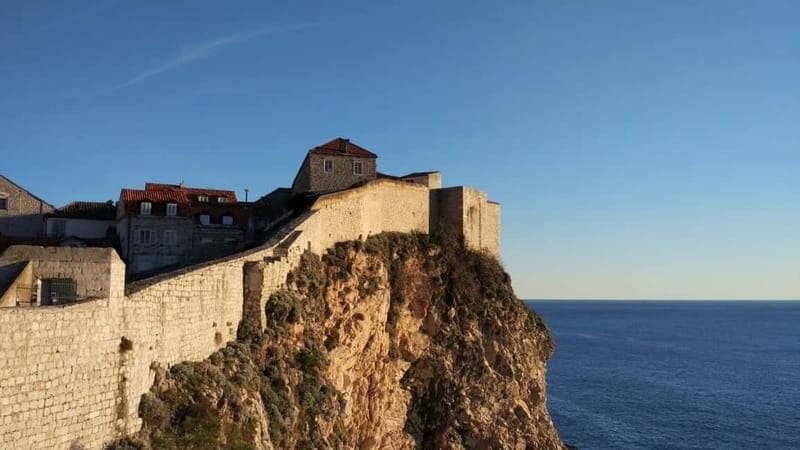
- A full circuit of the walls: The route includes Fort Revelin, Minčeta Fortress, Fort St. John, the Old Port, and views toward Fort Lovrijenac and Fort Bokar.
- A local English-speaking guide: Marko has received particular praise for his humor, enthusiasm, military knowledge, and ability to involve younger visitors.
- Small groups of up to eight: The size makes it easier to hear explanations and ask questions.
- Entrance costs extra: The tour is $36 per person, while the city-wall ticket is usually 40 euros, unless you have a Dubrovnik Pass.
- Not suitable for everyone: The experience is not recommended for wheelchair users, people with mobility impairments, people afraid of heights, or children under 12.
Starting by Fort Revelin and the Old Harbor
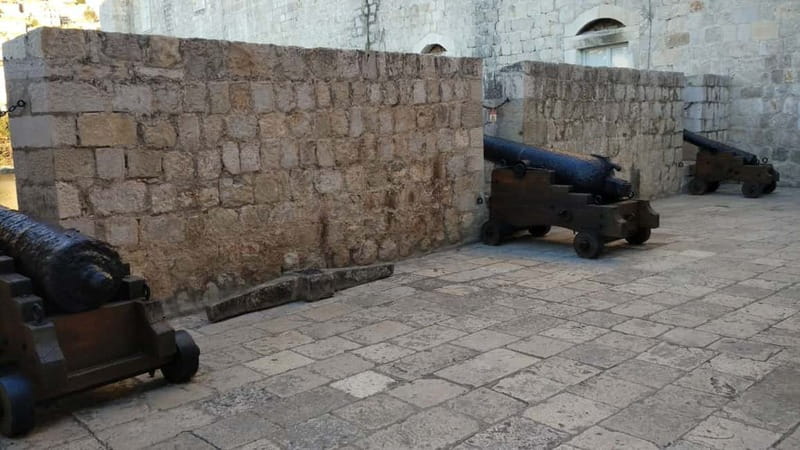
Your meeting point is easy to identify. Look for the guide in the corner of the square by the cannon, holding a red and white flag. The group gathers near Fort Revelin and Ploče Gate, on the eastern side of the Old Town.
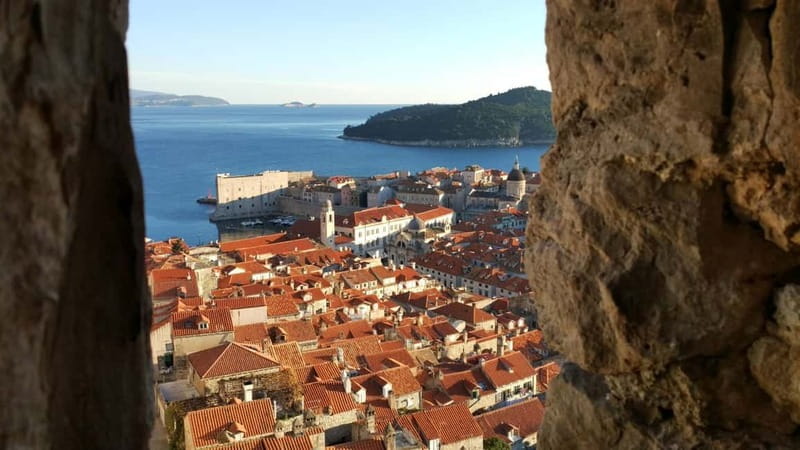
This is a smart place to begin because the first views explain why Dubrovnik built such formidable defenses. As you climb toward the walls, the Old Harbor opens below you. Your guide connects the water, the fortifications, and Dubrovnik’s maritime power, explaining how ships, trade, and seafaring helped the small republic prosper.
The harbor also explains the city’s defensive priorities. Dubrovnik needed to protect its ships and eastern approach from attack, so Fort Revelin became a key shield outside the main Old Town defenses. You are not simply looking at old stone. You are seeing a system designed around trade, access, and survival.
The first climb also sets the physical tone. The route includes repeated stairs and uneven walking surfaces, so use the opening section to judge your pace. This is not a tour where you can coast along at street level.
A few more Dubrovnik trips worth comparing
- Blue Cave Small-Group Boat Tour from Dubrovnik
★ 5.0 · 9,360 reviews - Full-Day Dubrovnik Elaphite Islands Cruise with Lunch and Drinks
★ 5.0 · 8,823 reviews - Dubrovnik: Epic Game of Thrones Tour + Lokrum & Saver Option
★ 4.9 · 5,995 reviews
Fort Revelin and the northern wall
Fort Revelin guarded the eastern approach to Dubrovnik for centuries. From the wall, you get a useful sense of how the fort worked with the gates, harbor, and surrounding defenses.
The northern stretch turns the walk into a practical lesson in medieval warfare. Your guide explains how defenders used bows and arrows, stone boulders, towers, and siege tactics. These details matter because they show how much planning went into every part of the wall. Towers were not built only to look impressive. They gave defenders height, protected weak points, and allowed them to watch approaches from several directions.
The tour also covers Dubrovnik’s relationship with the Ottoman Empire. This is one of the more interesting parts of the experience because the story is not reduced to a simple battle between enemies. Dubrovnik often relied on negotiation and careful diplomacy as much as on weapons. A small republic surrounded by stronger powers had to know when to fight, when to pay, and when to negotiate.
I like this political angle because it gives the walls a purpose beyond military spectacle. The stones tell one story, but the city’s survival depended on judgment and restraint too.
Minčeta Fortress and the best high view
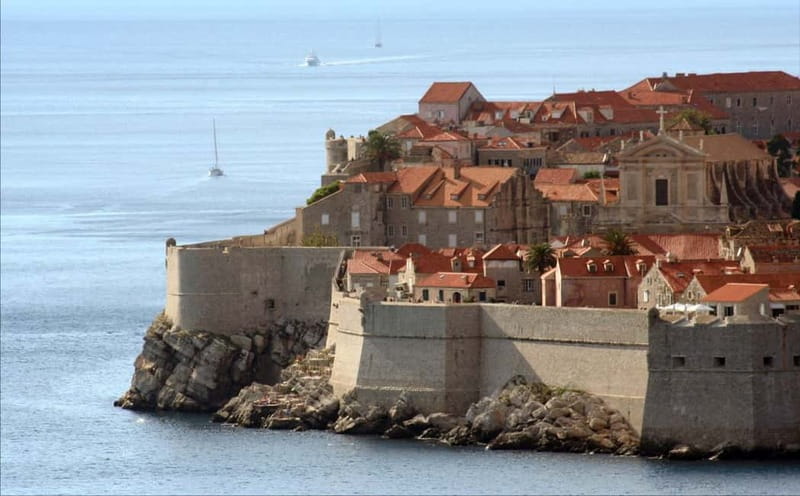
Minčeta Fortress is one of the tour’s key stops. It rises above the northern side of Dubrovnik and gives you a broad view over the Old Town and the Adriatic.
The guide discusses the role of the Italian architect Michelozzi in the fortress’s development, along with the old gun foundry and the cannons once used to defend the city. That combination of architecture and weaponry helps you see how the defenses changed as military technology changed. Thick medieval walls had to adapt to artillery, and fortresses needed stronger shapes and better positions.
This is also a good place to pause for photos, though the route provides several such moments. The higher view shows how tightly packed the Old Town is within its walls. You can also better understand the city’s relationship with the sea, since the walls are not an isolated monument. They form a ring around homes, churches, streets, gates, and the harbor.
The warm morning sun mentioned for this part of the walk can make Minčeta especially pleasant if you choose an early start. Starting times vary, so check availability when booking. You should also remember that the walls can feel exposed, and people afraid of heights may not enjoy the route.
Stradun from above
At one point, the route gives you a strong overhead view of Stradun, Dubrovnik’s main street. From the wall, the famous limestone thoroughfare appears in a different way than it does from street level.
You can see how Stradun links the eastern and western sides of the Old Town and how the city’s compact plan fits inside the defenses. This is one of the best photo stops because it combines the polished street, pale stone buildings, red roofs, and the surrounding wall system in a single frame.
The guide uses this view to connect daily life with defense. Streets inside a fortified city were shaped by practical needs, not only beauty. Looking down from the walls helps you understand how the protected town functioned as a working community.
Your guide can also answer questions throughout the route. That matters on a two-hour tour because you can follow up on details that catch your interest instead of listening to a fixed speech with no room for discussion.
Still Dubrovnik, at a slower pace:
- Dubrovnik: Elaphiti Islands Full-Day Cruise with Lunch
★ 5.0 · 5,938 reviews - Dubrovnik: Old Town Walking Tour
★ 4.8 · 5,174 reviews - Dubrovnik: The Original Game of Thrones Tour & Lokrum Option
★ 4.8 · 5,064 reviews - Dubrovnik Game of Thrones Tour & Optional Lokrum Island Visit
★ 5.0 · 4,702 reviews
Fort Bokar, Pile Gate, and Lovrijenac
The western part of the wall brings Fort Bokar and Fort Lovrijenac into focus. These defenses protected the vulnerable western approach and helped guard Pile Gate, one of the main entrances to the Old Town.
Lovrijenac is especially striking. Some parts of its walls reach 12 meters thick, a detail that makes the fort’s purpose plain. From the city wall, you can appreciate how the fort stood apart from the main defenses and helped control access from the sea and land.
This section is valuable because it shows that Dubrovnik did not depend on one continuous barrier alone. The city used separate forts, towers, gates, and harbor defenses that supported one another. The route lets you see those parts in relation to each other, which is far more useful than viewing each fort as a separate photo stop.
You may also find this stretch more exposed than the streets below. The height gives you the best views, but it can make the walk uncomfortable if you dislike open edges. The tour is not suitable for people afraid of heights, and that warning should be taken seriously.
The southern wall, Fort St. John, and the Old Port
The southern side of the walls looks back toward the sea and the Old Port. Here, your guide explains the oldest and youngest sections of the fortifications, along with Dubrovnik’s long rivalry and connection with Venice.
The Venetian connection adds another layer to the story. Both cities depended on shipping, trade, and control of the Adriatic, so competition was unavoidable. Dubrovnik’s leaders had to defend the city while preserving the commercial relationships that kept it alive.
Fort St. John marks another important point on the route. It helped protect the harbor and fits into the wider defensive plan you have been following since the start. By this stage, the tour has moved from the eastern approach, across the north and west, and around the southern sea-facing side.
The route then reaches the Old Port before returning to the starting area. Ending back at the meeting point is useful if you have later plans in the Old Town. You do not need to arrange a separate transfer, and you remain close to the city’s main sights and gates.
What the two-hour format does well
Two hours is enough to complete the circuit without turning the walk into an all-day commitment. You receive a clear outline of Dubrovnik’s military past, see the major forts and towers, and have time for photos and questions.
The small-group format is important here. With no more than eight people per guide, you should have a better chance of hearing the explanations clearly and asking about details that interest you. Marko is particularly praised for keeping the experience lively. His use of questions helped involve the group, and his humor kept the historical material from becoming a list of dates and names.
That style can be useful for families with older children. The minimum age is 12, but one 10-year-old was reportedly kept interested throughout a two-hour walk. Since the stated age rule excludes children under 12, you should follow the official restriction when booking.
The pace also depends on the group’s fitness. The route includes more than 700 stairs, and the repeated climbs can make two hours feel longer than expected. You should wear comfortable walking shoes and take the physical demand seriously, even if you plan to stop often for views.
Is the $36 price good value?
The $36 fee is reasonable for a small-group tour with a licensed English-speaking guide, but the total cost needs a closer look. The city-wall entrance ticket is separate and usually costs 40 euros for most of the year.
That means the experience is not really a $36 outing unless you already have a Dubrovnik Pass. With the pass, you can enter the walls for free and skip the line, which makes the guided tour much better value. If you do not have one, you can buy the entrance ticket at the gate by cash or card.
The seasonal ticket price is lower in January, February, November, and December, when it costs 20 euros. Students with a valid ISIC card and people under 18 pay 15 euros. The tour itself remains a useful purchase in any season if you want context, but the combined price is easiest to justify when the guide’s explanations are a priority for you.
I would not choose this tour only for access. You can visit the walls without a guide. I would choose it for the way the guide links Fort Revelin, Minčeta, the harbor, Fort St. John, Bokar, Lovrijenac, Venice, and the Ottoman Empire into one clear story.
Who will enjoy this walk most?
I recommend it most for people who want history explained on site rather than read from a plaque. The military focus is also a good match if you are interested in fortifications, naval power, siege methods, or the political choices of small states.
It suits active adults and older children who can manage a long stair-filled walk. The small group is helpful for anyone who prefers conversation and questions over a large crowd.
You should think twice if you have walking difficulties, a low fitness level, or a mobility impairment. The route is not wheelchair accessible, has no elevator or escalator, and includes more than 700 stairs. It is also not suitable for babies under one year or children under 12.
The route can be physically demanding even when the weather is pleasant. I would plan your other sightseeing around it rather than squeezing it between several major activities.
Booking details worth knowing
The tour lasts two hours, with starting times based on availability. The guide speaks English, and the activity begins and ends at the square near Fort Revelin.
You can cancel up to 24 hours in advance for a full refund. The reserve-now, pay-later option also gives you some flexibility if your Dubrovnik plans are still changing.
The most important practical tip is to confirm your wall-entry plan before you arrive. If you have a Dubrovnik Pass, use it. If not, allow for the separate ticket cost and be ready to pay at the entrance by cash or card.
Should you book the Dubrovnik walls tour?
Book this tour if you want the full wall circuit explained by a local guide, especially if military history and Dubrovnik’s political survival interest you. Marko’s engaging approach, strong local knowledge, and ability to keep younger people involved add real value to the two-hour format.
Skip it if you mainly want a quick scenic walk, dislike heights, or cannot comfortably manage more than 700 stairs. Also check the total cost before booking, since the 40-euro standard entrance ticket can cost more than the tour itself.
For the right person, this is a focused and worthwhile way to understand Dubrovnik. You get the views, but you also learn why the harbor, forts, towers, gates, and diplomacy mattered so much to the city’s survival.
FAQ
How long does the Dubrovnik walls tour last?
The tour lasts two hours. Starting times vary, so you should check availability for your chosen date.
Is the city-wall entrance ticket included?
No. The entrance ticket is separate from the $36 tour price. It usually costs 40 euros, but prices are lower in certain winter months, and some visitors qualify for reduced rates.
Can I use a Dubrovnik Pass for entry?
Yes. A Dubrovnik Pass allows you to enter the walls for free and skip the line.
Where does the tour meet?
Meet in the square near Fort Revelin and Ploče Gate. Look for the guide by the cannon, holding a red and white flag.
How many stairs are on the tour?
There are more than 700 stairs. The tour requires a moderate level of fitness and has no elevator or escalator.
Is the tour suitable for children and wheelchair users?
The tour is not suitable for children under 12, wheelchair users, people with mobility impairments, people afraid of heights, or people with a low level of fitness.
Just added around Dubrovnik
- Elaphiti Islands Private Dubrovnik Boat Unique Experience★ 5.0 · 10 reviews
- Full- Day Private Speedboat Tour in Dubrovnik on Elaphiti Islands★ 5.0 · 21 reviews
- PRIVATE Wine Tour to Konavle country side★ 5.0 · 11 reviews
- Wine Lover’s Tour of Peljesac Peninsula★ 5.0 · 150 reviews
- Wine tour peninsula Pelješac★ 5.0 · 3 reviews
- Parasailing in Cavtat★ 5.0 · 62 reviews
- Welcome to Dubrovnik Walking Tour★ 5.0 · 36 reviews
- Dubrovnik at War 1991-1992 Private Walking Tour★ 5.0 · 4 reviews
2-Hour Experiences, compared.

2-Hour Cetina River Boat Tour and Nature Park Visit
Read our review →
3h Morning or 2h Afternoon Kayaking & Snorkeling
Read our review →
Dubrovnik 2-Hour Uncertified Divers Introductory Dive
Read our review →
Private Transfer from Dubrovnik to Split with 2 hours for sightseeing
Read our review →


2-Hour Dubrovnik Fun and Exciting Jet Ski Safari Adventure Tour
Read our review →Browse the lists this tour appears in