Reviewed · GUIDED
Rovinj guided tour – personally ( german )
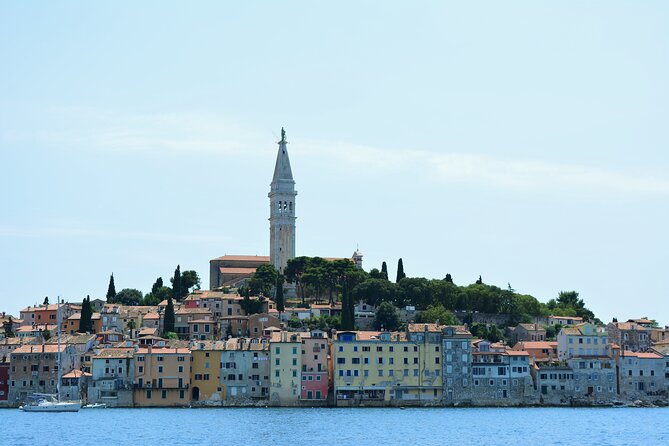
Rovinj rewards a closer look. This private, German-speaking walk makes the old town easier to read, and I especially like the small-group format and guide Marina’s clear German. The tour also brings you to the Rovinj batana boats, a local tradition many visitors could easily miss. The main drawback is the price: $63.67 per person for about 90 minutes can feel high if you are traveling alone or as a pair.
You meet at 2 p.m. on Trg Maršala Tita and finish at the same point. The route covers the old town at a steady pace, with no admission fees listed for the stops. If you want a longer visit inside museums or more free time for photographs, this focused walk may feel a little brisk.
In This Review
- Key points at a glance
- Why a private walk helps in Rovinj
- Starting at Balbi Arch
- Trg G. Matteottija and the town hall
- Renaissance houses at Garzotto
- Grisia Street, where art replaces the market
- St. Euphemia and Rovinj’s patron saint
- Old Town lanes, balconies, and fortress walls
- The Gate of the Holy Cross
- Rovinj harbor and the batana boats
- What $63.67 buys you
- Timing, meeting point, and pace
- Who should book this Rovinj tour?
- Should you book it?
- FAQ
- How much does the Rovinj guided tour cost?
- How long does the tour last?
- What language is the tour offered in?
- When does the tour start?
- Where does the tour meet?
- Where does the tour finish?
- Is this a private tour?
- Can I cancel for a full refund?
Key points at a glance
- A private German-speaking walk: Only your group takes part, with Marina guiding in German.
- Eight central stops in 90 minutes: The route links Rovinj’s gates, squares, lanes, church, walls, and harbor.
- History you can see around you: Venetian symbols, Renaissance houses, old fortifications, and narrow streets all become part of the story.
- A close look at batana boats: The wooden fishing boats in the harbor connect Rovinj’s working past with Croatian cultural heritage.
- Useful for first-time visitors: The route gives you a clear map of the old town and explains why Rovinj is called Little Venice.
- Flexible cancellation: You can receive a full refund when you cancel at least 24 hours before the start time.
Why a private walk helps in Rovinj
Rovinj’s old town is compact, but it is not simple. Streets twist uphill toward the Church of St. Euphemia, lanes open suddenly into small squares, and old houses crowd close to the water. Without context, you may notice the colors and stonework but miss the reasons behind them.
That is where a private guide earns the fee. You can ask about the town’s peninsula setting, the patron saint, Venetian influence, and local boats as they appear in front of you. A private format also means the pace belongs to your group, at least within the 90-minute schedule.
Marina’s German was praised as clear and easy to understand, and she answered questions thoroughly. That matters on a history walk. You are not just following a flag through the streets. You can stop briefly when a detail catches your eye and ask for an explanation in your own language.
The tour is also a good choice for families or mixed-age groups because the route does not depend on long museum visits. Most people can participate, and service animals are allowed. Still, the old town includes narrow streets and an uphill approach to the church, so anyone concerned about walking should keep the route’s historic setting in mind.
A few more Rovinj trips worth comparing
- Rovinj: Sunset Cruise with Swim Stop, Drinks, and Fruits
★ 4.9 · 944 reviews - Rovinj: Sunset Boat Trip with Dolphin Watching
★ 4.6 · 644 reviews - From Poreč: Lim Fjord, Rovinj, and Vrsar Boat Trip
★ 4.7 · 276 reviews
Starting at Balbi Arch
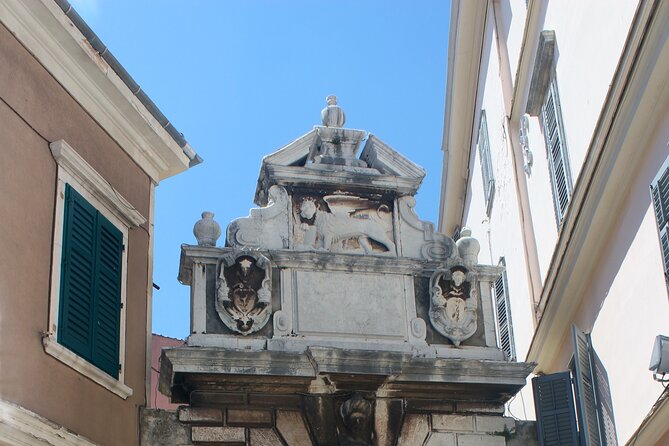
The meeting point is Trg Maršala Tita 7, and the first stop is Balbi Arch. This is a sensible place to begin because the arch marks the entrance into Rovinj’s old town and its maze of lanes.
Look above the passage for the Venetian lion. The guide explains what that symbol meant and how it relates to Rovinj’s past. A small detail like this can change the way you read the rest of the walk. Venetian marks are not random decoration here. They point to the political and cultural forces that shaped the town.
You spend only about five minutes at the arch. That is enough for an introduction, not a long lecture. I like this opening because it gets you moving quickly while giving you a question to carry into the next streets.
Trg G. Matteottija and the town hall
The next stop is Trg G. Matteottija, where you see the town hall and the imposing city palace. The building dates from the 16th century and still houses the city administration.
This stop gives the walk a useful civic angle. Rovinj was not only a fishing town of picturesque alleys. It also had institutions, officials, and a formal center of local government. Your guide can connect the building’s appearance with the city’s political past.
The planned visit is short, around five minutes. You will not get a full architectural study, but you will understand why this square matters. If you like to photograph facades, take your shot before the group moves on. The tour keeps a fairly tight rhythm.
Renaissance houses at Garzotto
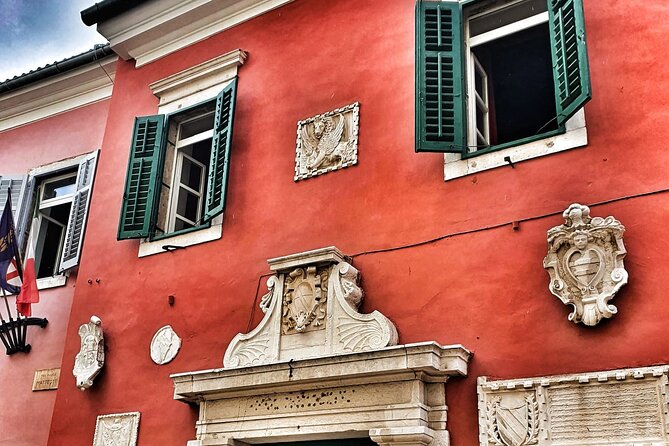
At Garzotto, also called the Great Square or Veliki trg, the story turns toward commerce. In the Middle Ages, this was a market square. Renaissance houses from the 16th century still frame the area, and the old town’s main streets once led toward this central meeting place.
I find this kind of stop more useful than simply being told that a building is old. A market square explains how people used the town. Streets were not laid out only for scenic walks. They connected homes, shops, work areas, and public space.
You have about five minutes here. That is brief, but the square works as a visual lesson. You can see how the town’s lanes gather around a shared center before the route turns toward Grisia Street and the church.
Still Rovinj, at a slower pace:
- Rovinj: Sunset & dolphin group tours with Catamaran
★ 5.0 · 227 reviews - Dolphin Sunset Adventure with Speedboat
★ 5.0 · 199 reviews - Rovinj: Golden Cape Desert Islands Kayak & Snorkeling Tour
★ 4.9 · 191 reviews - BUBA-Kayak Tours Rovinj FREE-drinks,pictures,snorkeling equipment
★ 5.0 · 178 reviews
Grisia Street, where art replaces the market
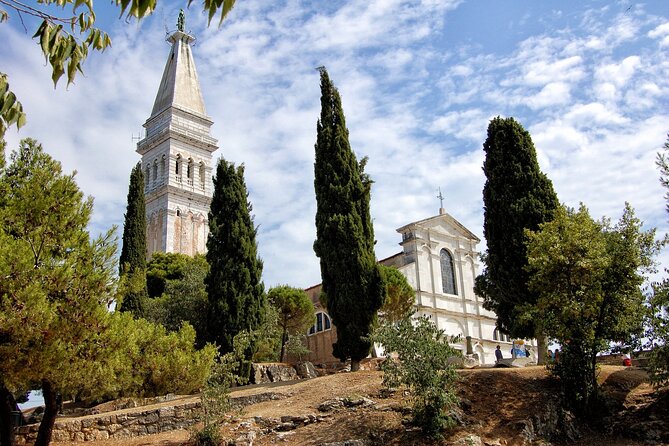
Grisia is one of Rovinj’s best-known lanes. It leads uphill toward the plateau of St. Euphemia and is lined with small art galleries.
The street gives you a different side of the old town. Instead of a single grand attraction, you get a close view of how historic streets remain part of daily life. The galleries add a modern layer without wiping away the old stone houses and narrow passage.
The walk allows about 20 minutes here, making Grisia one of the longer stops. That extra time is helpful. You can look at the galleries, notice the lane’s slope, and hear how the street connects the lower town with the church above.
The practical point is simple: Grisia is more than a route between two sights. It is one of the places where Rovinj’s artistic identity is easiest to feel. If you want to browse carefully, though, the scheduled time may not be enough for extended gallery visits.
St. Euphemia and Rovinj’s patron saint
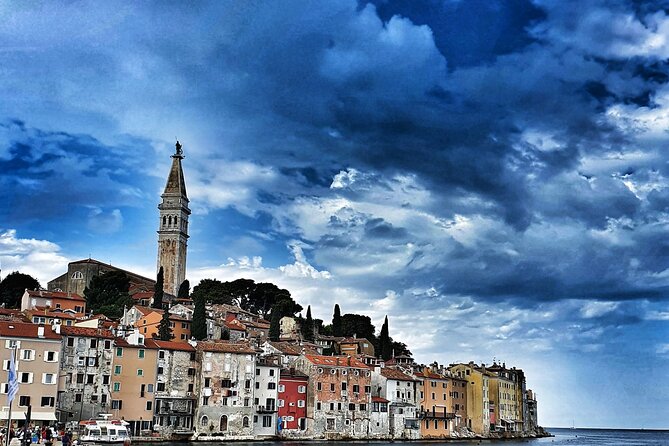
The Church of St. Euphemia is the spiritual high point of the tour. St. Euphemia is especially venerated in Rovinj, and the guide tells the legends connected with her life and death.
This is one of the moments when a local guide can add real value. A church is easy to photograph and easy to pass by. The story of the saint explains why the building matters so much to the city and why her name appears throughout Rovinj.
The stop lasts about 15 minutes. That gives you time to listen, take in the church setting, and connect the saint’s story with the town’s identity. The provided details do not promise a full interior tour or a special admission, so you should think of this as a guided historical stop rather than an extended church visit.
The uphill setting also gives the route a natural pause. After the lower squares and lanes, you reach one of the old town’s key landmarks and see how religious life shaped the town’s highest point.
Old Town lanes, balconies, and fortress walls
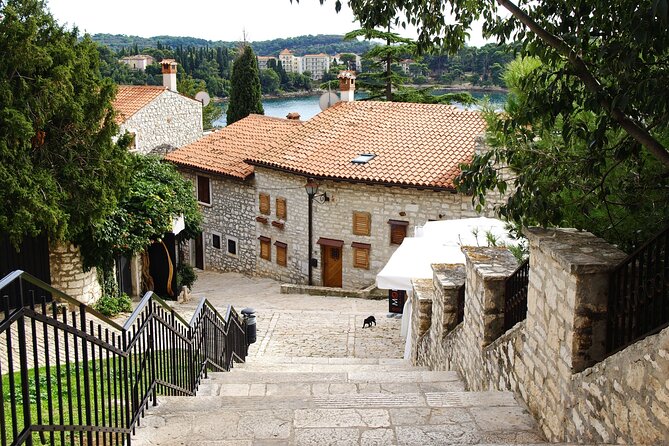
The old town section lasts about 20 minutes and brings together the visual details that make Rovinj memorable: winding streets, colorful houses, balconies, Istrian galleries called baladur, and old fortress walls.
This is where the tour’s central question gets its answer: how did thousands of residents live together on a small island for centuries? Tight streets and stacked houses were not just charming. They were practical responses to limited space.
The baladur is worth watching for. These traditional Istrian galleries add an extra outdoor level to the houses and help explain how architecture adapted to the local way of life. Your guide can point out features you might otherwise group together as simply old-fashioned.
The old walls also make the town’s defensive past easier to understand. You do not need a long military lecture to appreciate them. Seeing the remaining fortifications beside homes and lanes shows how closely defense, work, and domestic life once shared the same small area.
For me, this is the heart of the walk. The church and arch are clear landmarks, but the ordinary details tell you how Rovinj functioned. Give yourself a little extra time after the tour if you want to revisit a lane or take photographs without keeping up with the group.
The Gate of the Holy Cross
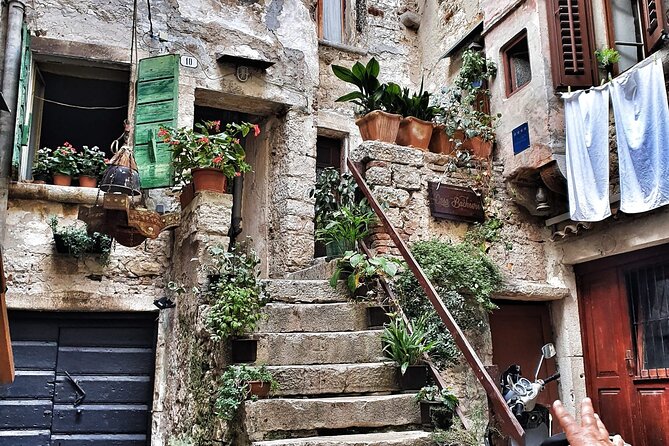
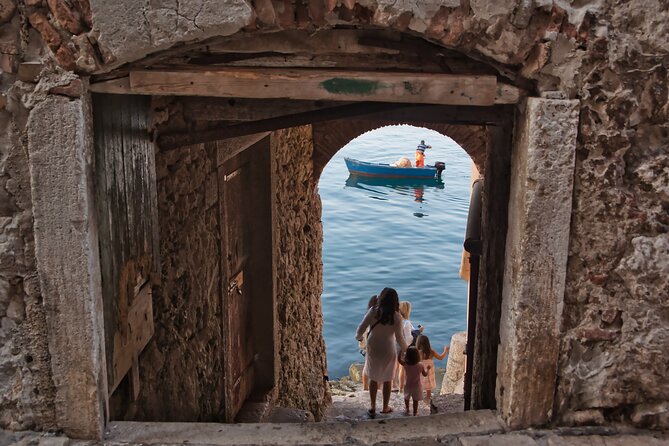
On Ulica Sv. Križa, you see the Gate of the Holy Cross, one of seven entrances that once served Rovinj. Three remain today.
This is a quick stop of about 10 minutes, but it helps you picture the old town as a defended settlement rather than a postcard backdrop. Gates controlled movement, marked the edge of the town, and connected the built-up center with the outside world.
The gate also gives the route a nice change of scale. You move from the broad idea of fortress walls to one specific opening used by people entering and leaving. I appreciate stops like this because they make urban history tangible.
Rovinj harbor and the batana boats
The final stop is the port, where you see the batana, a distinctive wooden boat associated with Rovinj. Local shipbuilders often built these boats on the ground floor of their own homes, and the Rovinj batana is recognized as Croatian intangible cultural heritage.
That detail makes the harbor stop more than a pleasant ending by the water. The boat connects the town’s narrow houses with its working life. Homes were also places of production, and the shoreline was tied directly to local livelihoods.
You have about 10 minutes at the port. It is enough to see the boats and hear why they matter, but not enough for a long harbor visit. If traditional crafts and everyday history interest you, this may be the most distinctive part of the tour.
The batana also helps explain why the guide’s questions are well chosen. Rovinj’s story is not only about Venice, saints, and old stone. It is also about people making a living from the sea and building what they needed close to home.
What $63.67 buys you
At $63.67 per person, this is not a bargain-priced orientation walk. The value depends heavily on your group size and your interest in German-language guiding.
For a private group, the price buys more than a route through the center. You receive a personal explanation of the town, the chance to ask questions, and a guide who can connect small details to larger themes. Marina’s strong German and willingness to answer questions are important here.
The price is easier to justify for a family or a small group that would otherwise need separate language arrangements. Group discounts may also improve the value, though the exact discount is not specified.
The calculation is less favorable for one or two people who only want a quick introduction. The tour lasts approximately 90 minutes, and it does not list paid admissions or extended interior visits. You are paying mainly for the private guiding, language service, and focused route.
I would book it early if the timing matters. It is booked, on average, 24 days ahead. That does not guarantee that every date fills, but it suggests you should not leave it until the last afternoon of your stay.
Timing, meeting point, and pace
The tour begins at 2 p.m. at Trg Maršala Tita 7 in Rovinj and ends back at the same meeting point. Because the route is circular in practical terms, you do not have to arrange transport back from a distant neighborhood.
The stop times add up to the advertised 90 minutes:
- Balbi Arch: about 5 minutes
- Trg G. Matteottija: about 5 minutes
- Garzotto: about 5 minutes
- Grisia Street: about 20 minutes
- Church of St. Euphemia: about 15 minutes
- Old Town: about 20 minutes
- Gate of the Holy Cross: about 10 minutes
- Port: about 10 minutes
The pace is purposeful. You move through several connected parts of the old town rather than settling into one square for a long talk. Wear comfortable shoes and expect the route to include narrow lanes and an uphill section toward the church.
The tour is near public transportation, but the experience itself is a walking tour. No transport between stops is included or needed.
Who should book this Rovinj tour?
I would choose this walk if you want a German-speaking guide, prefer a private experience, and like learning the story behind ordinary streets. It suits first-time visitors who want a clear orientation before exploring alone.
It is also a strong fit for couples, families, and small groups who enjoy asking questions. The private setup gives you more control than a large group tour, and the route includes both famous points and less obvious details such as baladur galleries and batana boats.
You may want another option if you prefer a slow photography walk, a museum visit, or a tour with extensive church interiors. Ninety minutes passes quickly, especially with eight stops. The tour gives you a framework, then leaves you to explore further.
The German-language detail is central, not incidental. If you are comfortable in English or Croatian and mainly want a basic map of the town, the price may be harder to defend. If clear German explanations make the difference between recognizing a sight and understanding it, Marina’s service adds meaningful value.
Should you book it?
Book this tour if you want Rovinj explained by a local German-speaking guide rather than simply photographed. Marina’s clear German, careful answers, and the private format are the strongest reasons to choose it.
The batana boats, old gates, Grisia galleries, and baladur balconies give the walk more substance than a quick landmark checklist. Just keep the price and pace in mind. At $63.67 per person for 90 minutes, it makes the most sense for a group that values personal guiding and shared language.
If you book, arrive ready to walk, listen, and look up. Rovinj keeps many of its best clues above the doorway, behind an arch, or along a lane you might otherwise rush past.
FAQ
How much does the Rovinj guided tour cost?
The tour costs $63.67 per person. Group discounts are available, but the exact discount is not specified.
How long does the tour last?
The tour lasts approximately 1 hour and 30 minutes.
What language is the tour offered in?
It is a German-language tour with a German-speaking city guide. Marina is named as the guide in the provided information.
When does the tour start?
The tour starts at 2 p.m.
Where does the tour meet?
The meeting point is Trg Maršala Tita 7, 52210 Rovinj, Croatia.
Where does the tour finish?
The activity ends back at the meeting point.
Is this a private tour?
Yes. Only your group participates in the activity.
Can I cancel for a full refund?
Yes, if you cancel at least 24 hours before the experience start time. Cancellations made less than 24 hours in advance are not refunded, and changes within that period are not accepted.
Just added around Rovinj
- Istrian tapestry – gourmet tour combining wine, truffles and olive oil★ 5.0 · 12 reviews
- Walking tour of Rovinj★ 5.0 · 4 reviews
- WW2&UNDERGROUND discovering the unknown EXTENDED TOUR★ 5.0 · 12 reviews
- Private Tour at Rovinj on a Golf Cart★ 5.0 · 7 reviews
- Vrsar, Lim Fjord and Rovinj Day Tour by Boat with Drinks★ 4.5 · 33 reviews
- Truffle and wine / Taste of Istria from POREC, ROVINJ, PULA★ 5.0 · 15 reviews
- Transfer Rovinj – Pula★ 4.5 · 3 reviews
- TUNNEL ABSEILING PLUS tour the underground★ 5.0 · 24 reviews
Guided, compared.
Plitvice & Rastoke Guided Day Trip with Ticket
Read our review →
Plitvice Lakes Guided Tour with Entry Tickets
Read our review →
Plitvice Lakes National Park Guided Day Tour from Split
Read our review →
Rastoke & Plitvice Lakes Guided Tour with Ticket
Read our review →